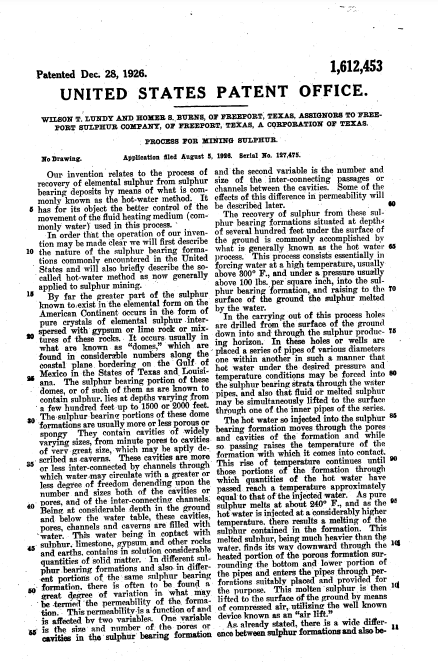
Founding Patents
Phelps Dodge
Founding Patent
-
Stronger, longer‑lasting rabble arms
The design gives the arm a much longer and more stable bearing surface without using a long boss that would overheat and burn away. This means the arm survives heavy mechanical stress and high‑temperature operation far better than older designs.
-
Prevents overheating and burn‑out
By using a short, cool-running boss and shifting the structural support into the arm itself, the invention eliminates the common failure mode where bosses burn off in service.
-
Simplifies installation and maintenance
The inner and outer tubes are permanently connected as a single unit, so workers no longer need to mount two separate components into two separate shafts. This reduces installation time, alignment issues, and labor costs.
-
Improves cooling efficiency
The airflow path is engineered to move smoothly through the inner tube, deflect outward, and return through the outer tube. This keeps the arm cooler, reduces thermal fatigue, and extends service life.
-
More reliable furnace operation
Because the arms stay cooler, stronger, and better supported, the rabble operates more consistently, reducing downtime and improving throughput in metallurgical roasting processes.
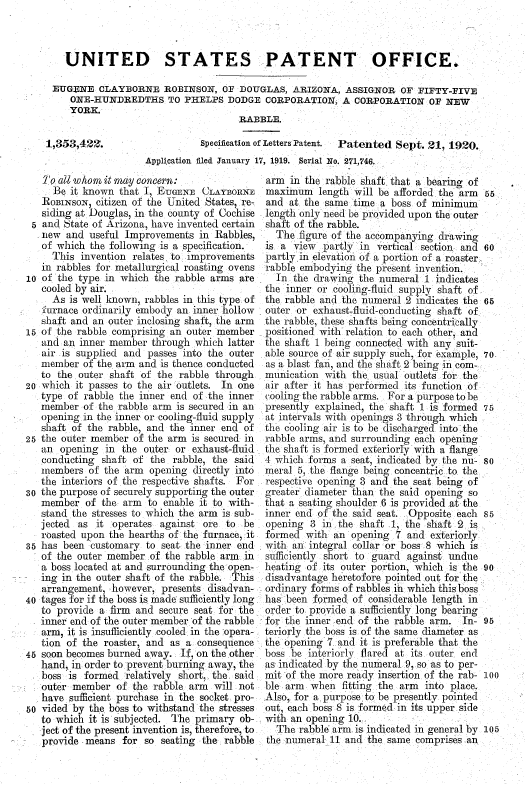
Freeport McMoRan
Founding Patent
-
Stronger, more reliable rabble arms
The design gives the arm a long, stable support surface without using a long boss that overheats. This dramatically improves durability during heavy furnace operation.
-
Prevents overheating and burn‑out
A short, cool‑running boss replaces the long, failure‑prone bosses used in older designs. This eliminates a major cause of breakdowns in roasting furnaces.
-
Faster, simpler installation
The inner and outer tubes are permanently connected as one unit, so workers no longer need to mount two separate parts into two different shafts. This reduces labor, alignment issues, and downtime.
-
Improved cooling performance
Air flows smoothly through the inner tube, reverses direction at the tip, and returns through the outer tube. This efficient airflow keeps the arm cooler and extends its service life.
-
More consistent furnace operation
With better cooling, stronger support, and fewer failures, the rabble operates more smoothly, improving throughput and reducing maintenance interruptions.